
Union Paint and Body Shop: 2026 Local Guide

Last Updated: October 24, 2026
Quick Summary
To choose a paint and body shop near Union, verify each listing's street address, phone number, and hours, since the name Union appears in towns across many states. Compare shops on itemized written estimates, review patterns, parts type, warranty terms, and turnaround time rather than star ratings or the lowest quote.
Add your county or ZIP code to the search so nearby shops surface first.
Skip listings with no street address, phone number, or recent reviews.
Ask whether the estimate assumes new OEM, aftermarket, or recycled parts.
Collision repair typically takes three to ten business days for moderate damage.
Ask the shop to write supplements possible pending teardown on the estimate.
Table of Contents
Union Paint and Body Shop: What to Know Before You Choose
Why the Word 'Union' Sends You in Circles
How to Read Auto Body Shop Reviews Without Getting Fooled
The Three Review Patterns That Actually Matter
What Your Auto Body Repair Estimate Should Tell You
Who Actually Sets the Price
Deductibles, Supplements, and the Bill You Actually Pay
Paint-Only Work Is Priced Differently
Questions to Ask an Auto Body Shop Before You Hand Over the Keys
How Long Does Collision Repair Take? A Realistic Timeline
Pricing, Insurance, and Warranty: Comparing Union-Area Shops
How to Judge Paint Matching Before You Commit
Parts Sourcing: The Question That Changes the Price
Warranty Terms Worth Reading Twice
Insurance and Claims Support
A Comparison Framework You Can Actually Use
Conclusion
Frequently Asked Questions
Union Paint and Body Shop: What to Know Before You Choose
Searching for a union paint and body shop can feel like shouting into a crowded room. "Union" is a town name, a labor term, and a label on dozens of unrelated listings nationwide.
Most people searching for a paint and body shop near Union County get results mixing local shops with directories for Union, South Carolina, Union City, and a dozen other places.
Why the Word 'Union' Sends You in Circles
"Union" appears in town names across New Jersey, South Carolina, Michigan, Alabama, California, Kentucky, and Pennsylvania, and search engines don't always know which one you mean. A listing labeled "Union paint and body shop" might sit in Unionville or Union Springs, not the Union area you're standing in.
Here's how to keep your search local:
Add your county or ZIP code to the query so nearby shops surface first.
Check the street address on every listing, not just the shop name.
Confirm the phone number by calling before you drive over.
A common mistake is trusting the map pin without reading the address. We've seen listings claim a service area while the actual shop sits in another state.
Watch Out If a listing has no street address, no phone number, and no recent reviews, skip it. Directory scrapers generate those pages automatically, and calling them wastes your time.
How to Read Auto Body Shop Reviews Without Getting Fooled
Auto body shop reviews are only useful when you read for patterns, not star averages. A 4.6 rating with 200 reviews tells you more than a perfect 5.0 with nine.

The Three Review Patterns That Actually Matter
Repeat complaints about the same issue. If several reviewers mention a repair that failed or paint that didn't match, that's a pattern, not bad luck.
Praise that names a specific person or process. "They walked me through the insurance claim line by line" carries more weight than "great service."
Response quality from the shop. A business that replies to critical reviews with specifics, not excuses, tends to handle problems the same way in person.
Ratings alone can mislead: a shop that collects reviews only at drop-off will look better than one that asks after the repair is finished. For more guidance on judging shops and reviews, browse our blog. Favor recent feedback over reviews from several years back.
What Your Auto Body Repair Estimate Should Tell You
An auto body repair estimate should list every part, labor hour, and paint material separately, with a total you can compare line by line. If it's a single lump sum, ask for a written itemized version before you hand over the keys. But an itemized estimate is only half the story, the other half is who is paying, how the number gets set, and what can legally change it after you sign.
Who Actually Sets the Price
When insurance is involved, the insurer's adjuster writes the initial estimate, and the shop either agrees or writes a competing estimate and negotiates line by line.
If you are paying out of pocket, the shop sets the price directly. Ask whether the quote assumes new OEM, aftermarket, or recycled parts, because that choice can swing the total more than any labor rate.
Deductibles, Supplements, and the Bill You Actually Pay
Three numbers decide what comes out of your pocket:
Your deductible. If your deductible is $500 and the approved repair is $3,200, the insurer pays $2,700 and you pay the shop $500. The deductible does not change because the repair is bigger, it is fixed by your policy.
Supplements. Hidden damage found after teardown is billed as a supplement, and the insurer must approve it before the shop proceeds. A trustworthy shop photographs the hidden damage and submits the supplement before ordering parts, so you are not surprised at pickup.
Betterment and depreciation. On an older vehicle, the insurer may pay for a used or aftermarket part and charge you the difference if you insist on new OEM. Ask about this before work starts.
Pro Tip Ask the shop to write "supplements possible pending teardown" on the estimate and to send you the supplement approval before installing the parts. It is a normal clause, and a shop that resists putting it in writing is telling you something.
Paint-Only Work Is Priced Differently
A paint-only job, a scuffed bumper, a faded panel, a door needing refinishing, is quoted very differently from collision repair. Paint work is priced mostly on labor hours for prep, masking, and spraying plus refinish materials, and materials can be a meaningful share of a small job because paint is mixed by the batch regardless of panel size.
For a deeper look at how costs break down, see our guide to auto body repair cost estimates.
Questions to Ask an Auto Body Shop Before You Hand Over the Keys
Before you commit, ask five questions: Who handles the insurance claim? What warranty covers the paint and bodywork? Which parts are being used? How long will the repair take? What happens if I find a problem after pickup? The answers separate shops that communicate from shops that don't.
Here's a checklist you can bring with you:
Can you put the estimate in writing with itemized parts and labor?
Do you work directly with insurance companies, or do I pay and wait for reimbursement?
What warranty do you offer on paint and on structural repairs?
If you're evaluating a specific local shop, it helps to see its services and credentials laid out before you visit. You can review what an auto body shop in Linden, NJ offers and compare it against your checklist.
How Long Does Collision Repair Take? A Realistic Timeline
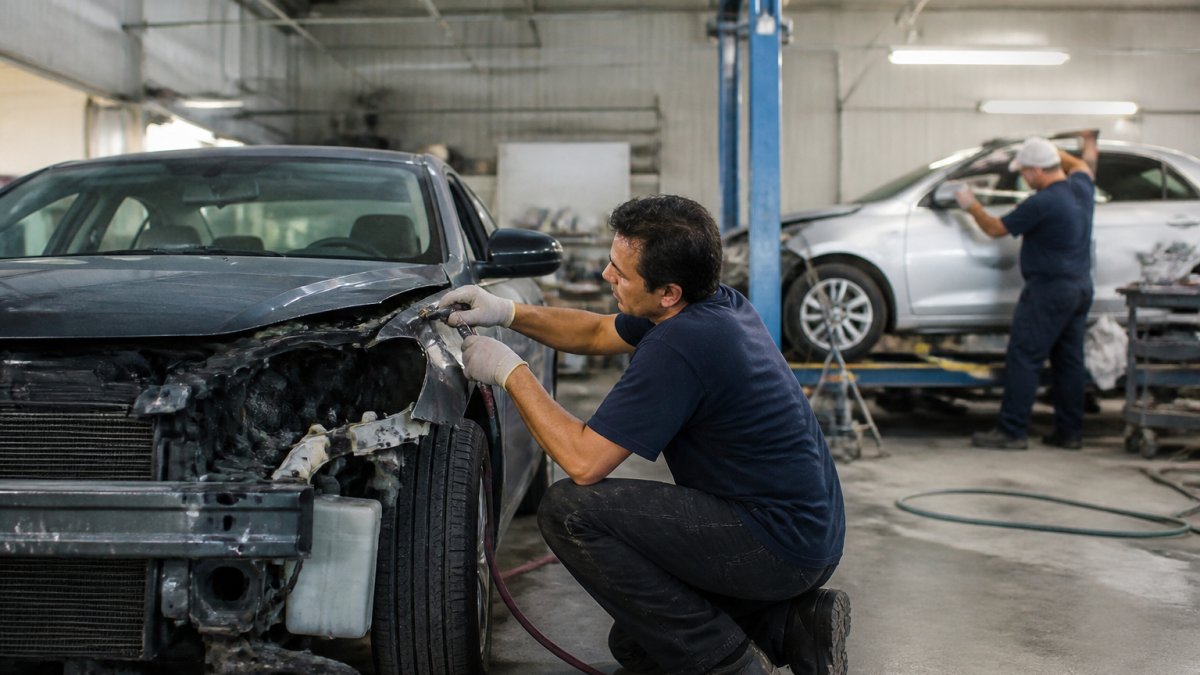
Collision repair typically takes three to ten business days for moderate damage, though parts availability and insurance approval can stretch that timeline. A bumper scuff might finish in a day or two. A frame pull with structural repairs can run two weeks or more.
The clock rarely starts at drop-off. Here's what actually happens:
Estimate and teardown (one to two days): the shop documents damage and orders parts.
Insurance approval (one to three days): the adjuster reviews the estimate and any supplements.
Parts delivery (varies widely): this is the biggest wildcard, especially for luxury and foreign models.
Body and paint work (two to five days): panel repair, prep, paint, and curing.
Reassembly and quality check (one day): trim, glass, and a final inspection.
Ask for a realistic window in writing, and ask what happens if parts arrive late. If you're still sorting out the steps that come before the repair, our post-accident guide covers who to call and what to document.
Pricing, Insurance, and Warranty: Comparing Union-Area Shops
Comparing Union-area shops comes down to five criteria: pricing transparency, insurance and claims support, repair quality and warranty terms, turnaround time, and customer experience. The cheapest estimate often excludes paint materials or supplements, which is why the final bill climbs. Compare shops on what you can verify on a phone call, not on adjectives.
How to Judge Paint Matching Before You Commit
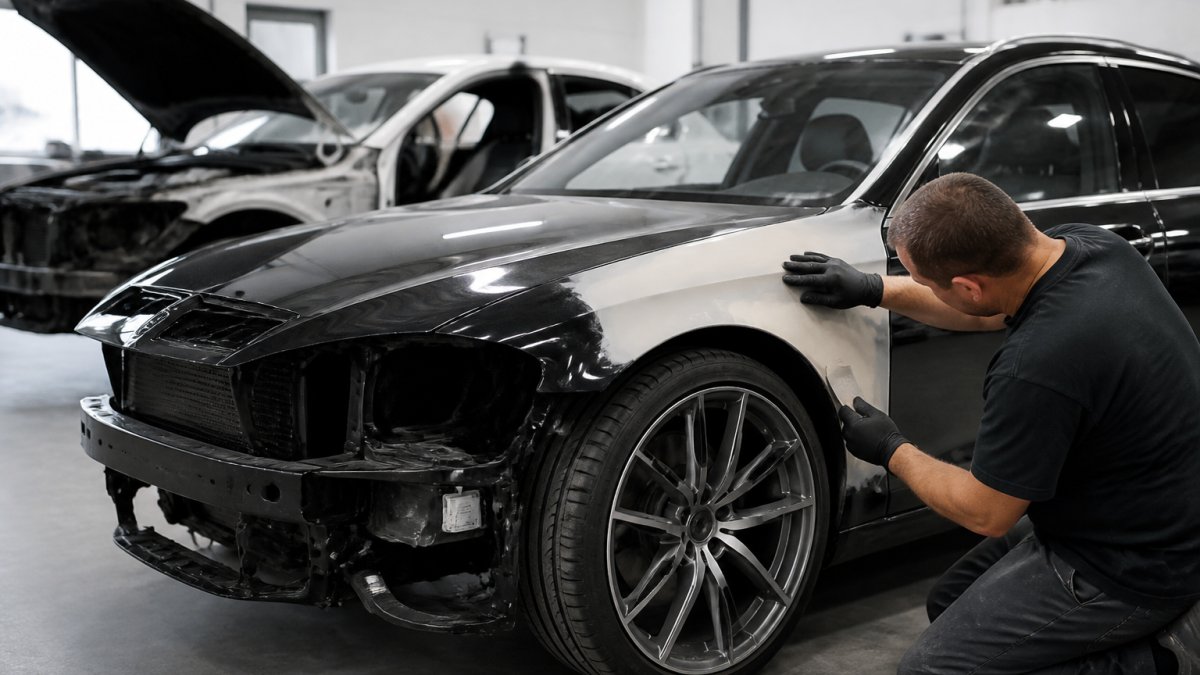
Paint matching is where cheap work shows up first. Modern finishes are usually three-stage, primer, base color, and clear coat, and metallic and pearl colors are hardest to blend because flake orientation changes with spray technique. Ask each shop three questions:
Do you blend into adjacent panels, or paint only the damaged panel? Blending is the standard practice for a color match that holds up in sunlight; panel-only painting is cheaper but more likely to show a visible edge.
Do you use a spectrophotometer to read the existing paint, or match by eye? A spectrophotometer reads the actual color on your car and accounts for fade, which matters on vehicles more than a few years old.
What is your warranty on the paint itself? A workmanship warranty that covers peeling, cracking, and excessive fading is the signal that the shop stands behind the match.
Parts Sourcing: The Question That Changes the Price
Ask every shop to state in writing whether the estimate assumes new OEM, aftermarket, or recycled parts, and whether you can request OEM. On a leased vehicle or one under a manufacturer warranty, OEM parts are often safer; on an older vehicle, aftermarket or recycled parts can be a reasonable cost trade-off. The shop should tell you which one it is quoting and why.
Warranty Terms Worth Reading Twice
A warranty is only as good as its exclusions. Ask for the written document, not a verbal promise, and read for:
Duration and coverage. Look for separate terms for paint, bodywork, and structural repairs, a single blanket number often hides a short paint term.
Transferability. Some warranties transfer to a new owner if you sell the car; others do not.
Exclusions. Rust repair, pre-existing damage, and damage from a later accident are commonly excluded, which is normal, but the exclusions should be spelled out.
Insurance and Claims Support
Ask whether the shop bills the insurer directly or expects you to pay and wait for reimbursement. Direct billing means the shop and adjuster settle the approved amount and you owe only your deductible; reimbursement means you front the full cost and wait for a check. Also ask whether the shop handles supplement approvals and photo documentation, that saves you hours on the phone.
A Comparison Framework You Can Actually Use
Use this framework when you call around, and write the answers down so you can compare them side by side:
Criterion | What to Ask | What a Good Answer Sounds Like |
Pricing | Is the estimate itemized and written, and which parts does it assume? | A written breakdown with parts type named |
Insurance | Do you bill the insurer directly, and who handles supplements? | Direct billing plus shop-handled supplements |
Paint | Do you blend adjacent panels, and do you use a spectrophotometer? | Blending standard, color read by tool |
Warranty | What is covered, for how long, and is it transferable? | A written document with separate terms |
Turnaround | What is the realistic completion window, and what happens if parts are late? | A written window with a delay plan |
Reviews | Do recent reviews mention the same issue twice? | Patterns, not one-offs |
Pricing for collision repair and auto painting depends on damage severity, parts, and paint type, so ask each shop for a written quote rather than relying on phone estimates. If you have narrowed the field, you can contact the shop to get warranty terms or a quote in writing.
Key Takeaway The best shop is not the cheapest or the fastest. It is the one that puts the estimate, parts type, warranty, and timeline in writing and explains the insurance process before you ask.
Conclusion
Choosing a paint and body shop near Union shouldn't require decoding a dozen same-named towns. Verify the address, read reviews for patterns, demand an itemized estimate, and get the warranty in writing.
If you'd rather skip the guesswork, E&A Supreme Auto Body is a locally owned collision repair shop serving drivers across Union County. We handle collision repair and professional auto painting for domestic, foreign, luxury, and exotic vehicles, walk you through insurance claims step by step, and offer financing for qualifying repairs.
Frequently Asked Questions
How do I choose a reliable paint and body shop?
Start by verifying the shop is licensed and insured, then read recent auto body shop reviews for patterns rather than single complaints. Ask for a written auto body repair estimate that lists parts, labor, and paint separately, and confirm the warranty in writing. Visit the shop in person to see whether the bays are clean and whether the staff explains the process without rushing you. A shop that invites questions and puts guarantees on paper is usually the safer choice.
Can I choose my own auto body repair shop after an accident?
Yes. In most states, including New Jersey, you have the right to choose the shop that repairs your vehicle, even when your insurer recommends a network shop. Your insurer may ask you to get an estimate from a shop they suggest, but you are not required to use it. If you pick a shop outside the insurer's network, ask the shop whether it works with your carrier and how it handles supplemental claims if hidden damage appears.
What should a written auto body repair estimate include?
A complete auto body repair estimate should list every part by name and whether it is new, used, or aftermarket, plus labor hours per panel, paint and refinish materials, and any diagnostic or calibration charges. It should also state the shop's warranty terms and note that the final bill may change if hidden damage is found. Ask for the estimate in writing before work begins, and keep a copy so you can compare it with the final invoice.
How long does paint and body repair usually take?
A minor dent or bumper scuff can take two to four days, while a multi-panel collision repair with paint matching often runs one to two weeks. how long does collision repair take depends on parts availability, insurance approval speed, and whether the frame or sensors need work. Ask the shop for a written timeline and a contact person who will update you if the schedule shifts, since delays usually come from backordered parts rather than labor.
Schedule service
Add easupremeauto.com as a preferred source on Google →
Comments